The Russia Anxiety by Mark B. Smith
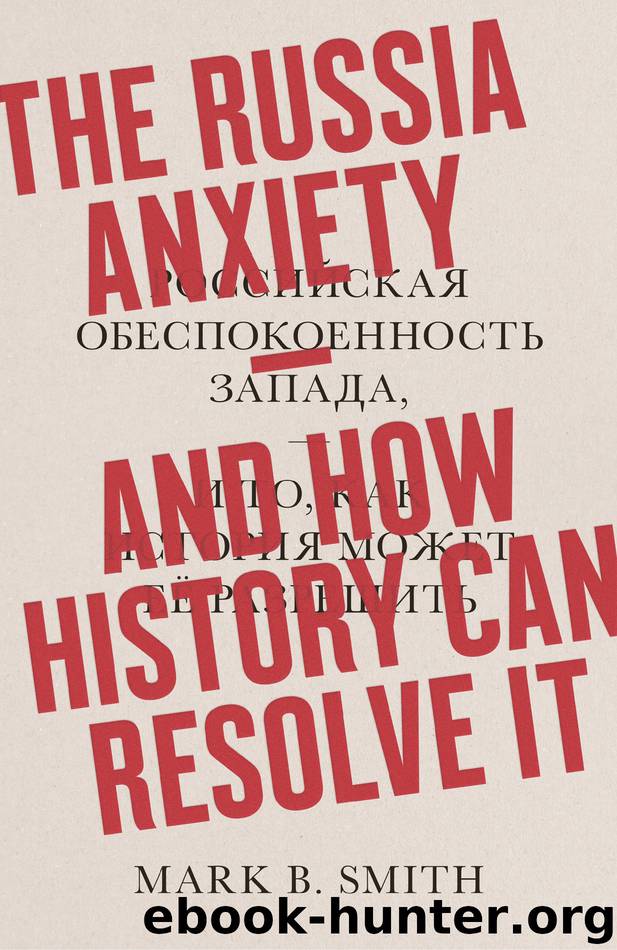
Author:Mark B. Smith
Language: eng
Format: epub
ISBN: 9780241312803
Publisher: Penguin Books Ltd
Published: 2019-06-12T16:00:00+00:00
EURASIA’S RUSSIA
Deep in the East, in the heart of Mongolia, a group of powerful tribal chiefs gathered in the year 1206. Their task was to declare their support for a new ruler: Chinggis Khan. Within a few years, he had transformed global politics, creating one of the great empires of world history. In 1206, the peoples over whom Chinggis ruled were nomads, capable of gliding on horseback across the steppe, sheep and cattle in tow, trading with those passing along the silk route. Gathered in strong family units but looking outwards for opportunities, they became a militarized civilization. In the Mongol lands, Chinggis was their charismatic and ambitious ruler. He moulded his disparate followers into a terrorizing force of tens of thousands of horse-riding warriors. His vision was brilliantly fulfilled in the north of China between 1210 and 1215. The Mongols smashed their way through Central Asia in 1219 and into today’s Iran and Afghanistan in 1221.
By 1223, western detachments had defeated the Polovtsy (the Turkic nomads who dominated the southern steppe). They were now an imminent threat to Rus. The following year, the Mongols defeated a divided force of surviving Polovtsy troops and men from some of the principalities of Rus. This was the limit of Chinggis’s reach. He died in 1227. Chinggis’s sons then continued the Mongol expansion. In the West, on the other side of the Volga river, it was his grandson Batu who pushed across the Urals and attacked Eastern and Central Europe between 1236 and 1241.
Eurasia – a linked-up political whole that ran across Europe and Asia, animated by a dominant civilization yet drawing strength from ethnic and cultural diversity – was coming into being, thanks to a 100,000-strong army from the East that targeted the East Slavic lands and captured Kiev. The descent of the Mongols on Muscovy was brutal and terrifying. Many thousands of subjects of Muscovy and the other territories of Rus were killed. The period of Mongol domination lasted for about 250 years, during which the terrible bloodthirstiness of the initial invasion was sporadically repeated. To take just one example: in 1408, the Tatar emir Edigai besieged Moscow, extorting thousands of rubles, and causing famine and plague. The ‘Golden Horde’ itself, as Mongol or Tatar overlordship is sometimes described, had its headquarters in Sarai in the south, was prone to division and civil war and was defeated by Tamerlane at the end of the fourteenth century. But the Mongols hung on, until their final defeat and expulsion in 1480.
We should not minimize the plight of those who suffered because of the Mongols: ignoring the victims breaks one of the first laws of studying history. But Mongol violence was not more barbaric than European violence; if anything, the real breakthrough in medieval barbarism came with the Christian attacks on the Holy Land in the First Crusade,59 which is no consolation to those who were violated and killed by a detachment of Mongol horsemen. Crucially, though, most of the 250 years of Mongol rule was a matter of diplomacy and governance rather than brute force.
Download
This site does not store any files on its server. We only index and link to content provided by other sites. Please contact the content providers to delete copyright contents if any and email us, we'll remove relevant links or contents immediately.
| Arms Control | Diplomacy |
| Security | Trades & Tariffs |
| Treaties | African |
| Asian | Australian & Oceanian |
| Canadian | Caribbean & Latin American |
| European | Middle Eastern |
| Russian & Former Soviet Union |
The Secret History by Donna Tartt(19088)
The Social Justice Warrior Handbook by Lisa De Pasquale(12190)
Thirteen Reasons Why by Jay Asher(8910)
This Is How You Lose Her by Junot Diaz(6887)
Weapons of Math Destruction by Cathy O'Neil(6280)
Zero to One by Peter Thiel(5802)
Beartown by Fredrik Backman(5754)
The Myth of the Strong Leader by Archie Brown(5507)
The Fire Next Time by James Baldwin(5446)
How Democracies Die by Steven Levitsky & Daniel Ziblatt(5219)
Promise Me, Dad by Joe Biden(5153)
Stone's Rules by Roger Stone(5088)
A Higher Loyalty: Truth, Lies, and Leadership by James Comey(4964)
100 Deadly Skills by Clint Emerson(4925)
Rise and Kill First by Ronen Bergman(4789)
Secrecy World by Jake Bernstein(4753)
The David Icke Guide to the Global Conspiracy (and how to end it) by David Icke(4720)
The Farm by Tom Rob Smith(4512)
The Doomsday Machine by Daniel Ellsberg(4490)
